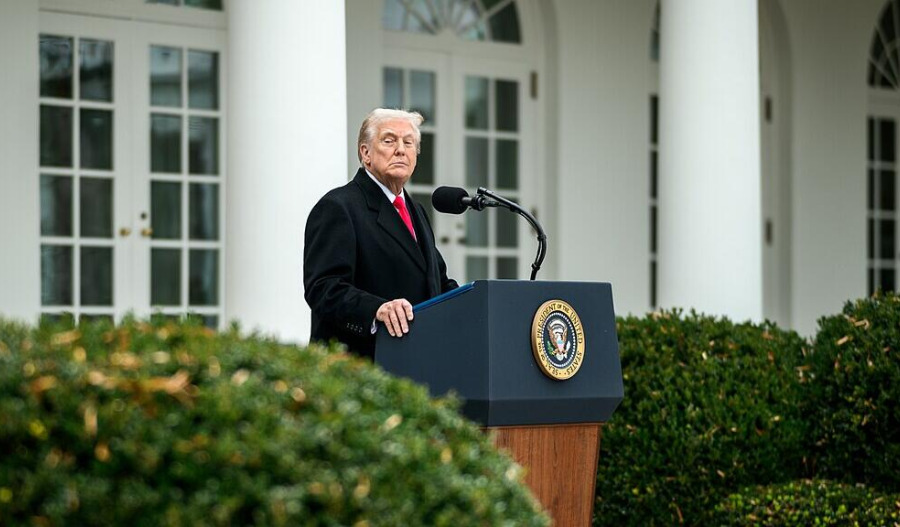

While United States presidents have always had the power to pardon whomever they like, with seeming impunity, they’re exposed to the broader court of public opinion, and with President Donald Trump’s popularity waning – plunging to 36% in Gallup’s latest poll – his latest round of pardons may contribute to his numbers continuing to head south.
While billionaire ChangPeng Zhao - former CEO of Binance - and Nikola Corporation founder Trevor Milton are among the gallery of rogues pardoned by Trump this year, so too is former Honduran President Juan Orlando Hernandez.
A convicted drug trafficker, Hernandez was reported to have accepted a $1 million bribe from convicted drug lord, El Chapo Guzman, head of Mexican cartel Sinaloa.
Rogue’s gallery of pardoned convicts
While Trump granted clemency to 238 individuals during his first term as president, that number shot up to around 1,700 after barely a year into his second term in the Oval office.
During the first day of his second term (January 20, 2025), Trump issued mass pardons and commutations to almost 1,600 people convicted or charged in connection with the January 6 United States Capitol attack - in which 5 people died and over a hundred police officers were injured.
Last month, the U.S. president announced pardons for 77 people associated with the so-called "fake electors" plot related to the 2020 election, including former New York mayor Rudy Giuliani and Mark Meadows who were both White House staffers during Trump’s first bout in office.

Could Trump pardon himself?
While it’s currently the subject of constitutional argument, there’s growing speculation that Trump could get away with ‘ring barking’ himself from future prosecution – once out of office with a self-pardon.
However, while a presidential pre-emptive self-pardon may not be out of the question, it would not prevent his potential impeachment.
Given that ten months into Trump’s second term, his administration has already been sued over 200 times, one way to shield himself from future fallout - once out of office - is to grant himself clemency.
After his first term, Trump famously was found guilty of fraud in 2022, and the court ordered Trump to pay out nearly $400 million, although the ruling was later reversed.
He was also sued for 2020 election interference, with his lawyers cited a Supreme Court’s ruling on immunity as grounds to dismiss the case.
Commenting on the cases against him, in 2018 Trump tweeted:
“I have the absolute right to PARDON myself.”
He continued, “but why would I do that when I have done nothing wrong?”
Random pardons from years passed
Over the past 249 years, U.S. presidents have used their powers to pardon a vast cross-section of the human condition.
Throughout the last two and a half centuries, presidential pardons have never ceased to raise eyebrows.
At the end of his term as president in 2001, Bill Clinton granted a controversial presidential pardon for his brother’s 1985 conviction of cocaine possession and drug trafficking.
A decade earlier, President Gerald Ford issued a pre-emptive pardon to Richard Nixon of Watergate scandal infamy before any charges were brought against him.
Interestingly, in 1977, Ford also felt the need to pardon Iva Toguri - aka Tokyo Rose – the notorious WWII siren who was convicted of treason for broadcasting propaganda that undermined the confidence of GIs fighting the war in the Pacific.
Fast forward to January 2025, and in the final minutes of his presidency, President Joe Biden preemptively pardoned several family members, including his brothers James and Frank Biden, and sister Valerie Biden Owens.
Biden claimed that his pardons were intended to shield his family from politically motivated attacks and should not be mistaken as an acknowledgment of any wrongdoing.
Biden’s eleventh-hour move follows another set of pardons issued to Covid-19 response chief Anthony Fauci and members of the House 6 January riot investigation to prevent what he called "unjustified... politically motivated prosecutions.
Is Julian Assange deserving of a presidential pardon?
While the bulk of Trump’s pardons relate to known political supporters or his inner-circle of associates, he did, prior to winning his second term in office, contemplate pardoning Julian Assange.
The WikiLeaks founder was released from custody in June 2024 following a 14-year legal battle, which only ended after he was forced to plead guilty to a charge of conspiring to obtain and disclose classified documents.
Unsurprisingly, while no U.S. president has ever pardoned a whistleblower, former president Barack Obama provided whistleblower Chelsea Manning executive clemency when he commuted the sentence by allowing her release from prison, but this was not a full pardon.
Given that Trump is understood to be preparing to issue a full and unconditional pardon for Edward Snowden, a former National Security Agency subcontractor, convicted of espionage in 2013 - after leaking thousands of top-secret records – there’s hope that a pardon for Assange could follow.
Had the plea deal not occurred, a U.S. President does have the constitutional authority to grant pardons for "offences against the United States", except in cases of impeachment.