


While 2025 ended with bond prices falling and significantly higher yields compared to the start of the year due to pesky inflation and talk of possible rate hikes, Vanguard Australia expects local bonds and equities to outpace both global and U.S. peers in 2026.
In a year marked by volatility and a shift in sentiment from expected rate cuts to potential hikes early this year, the Australian 10-year bond yield moved from 4.413% in December 2024 to 4.760% in December 2025.
Over the same time frame, the Australian two-year bond yield moved from 3.886% to 4.06%.
Underscoring strong market depth and global investor interest, the Aussie bond market witnessed a near-record year issuance of A$320.07 billion in 2025, a shade below the 2024 record.
According to Bloomberg’s year-end league table, the nation’s largest bank, Commonwealth Bank (ASX: CBA) topped to Australian bond market league table for corporate bonds in 2025 with $31.7 billion in bond deals, while Westpac (ASX: WBC) went from first to second place in 2025, writing $29.7 billion in bond deals.
While the dominance of government and banks as issuers is still clear in the bond market data, a growing number of non-Australian entities are issuing Australian dollar bonds into the local market.
Markets are exuberant
Within its 2026 Economic and Market Outlook, the global asset manager notes financial markets are “exuberant” thanks to strong fundamentals, AI investment and economic productivity.
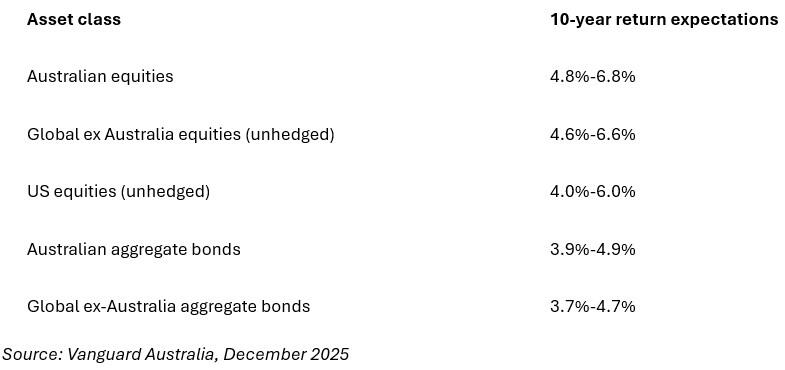
Vanguard Australia‘s 10-year annualised return forecast for Australian equities is 4.8% – 6.8%, above U.S. equities (unhedged) and global-ex Australia equities (unhedged) which are forecast to see 10-year annualised returns of 4.0-6.0 % and 4.6-6.6% respectively.
The global asset manager remains most guarded in its assessment of U.S. growth stocks, with its muted expected returns for the technology sector aligning with its more bullish prospects for an AI-led US economic boom.
Vanguard’s 10-year annualised forecasts
Vanguard Australia doubts U.S. technology stocks will meet bullish expectations due to the already-high earnings expectations and typical underestimation of creative destruction from new entrants into the sector which erodes aggregate profitability.
“Our muted US stock return forecast of 4.0%-6.0% average returns over the next 10 years is nearly single-handedly driven by our risk-return assessment of large-cap technology companies,” Vanguard Australia said.
On the bonds side, Australian aggregate bonds are forecast to return 3.9-4.9% on an annualised 10-year basis.
As with the equities, this is higher than global ex-Australia aggregate bonds (hedged) which are forecast to return 3.7-4.7%.

Fixed income allocations in 2026
Meanwhile on the fixed income front, allocations are also shaping up to be an increasingly attractive option for investors in 2026.
According to the Bloomberg Global Aggregate Bond Index, yields are back, after falling as low as 1-2% between 2016 and 2021, on average yields have normalised to a pre-financial crisis range of 4-5%.
For long-term investors relying on fixed income as a source of stable returns, investment specialist Insight Investment head April LaRusse said these numbers offered an optimistic outlook.
Echoing similar sentiment, Schroders head of fixed income Kellie Wood noted that after a protracted period of ultra-low rates, bond yields had normalised.
"For long-term investors, this new environment re-establishes fixed income as a viable source of stable, real returns," she recently told the market.
Higher yields are here to stay
Neither LaRusse nor Wood expect yields are to return to their previous lows, with yields being underpinned for an extended period by central banks and governments pursue expansionary policies to create high-pressure economies.
"While major central banks are in the process of gradual easing following a post-pandemic surge in inflation, persistent inflationary forces underpinned by deglobalisation and expansionary fiscal programmes suggest yields are likely to remain in a higher range in the years ahead," LaRusse said.
She believes higher starting yields, which increase income and capital buffers, improved the risk-return profile of fixed income portfolios and presented itself as an asset class with improved fundamentals and no potentially lower risk and attractive returns.
"Higher starting yields. For strategic asset allocation, fixed income resumes its role as a "ballast," providing income and diversification against risk assets,” she said.
Timely entry into FI
Based on recent economic data and heightened expectation of a rising cash rate in 2026, LaRusse believes allocating more towards fixed income securities is a no brainer.
But with rate volatility likely to persist, Wood reminds investors that managing exposure on the yield curve is also vital.
"Given recent stronger than expected economic data, the futures market is now pricing that official interest rates will rise to 4% from the current 3.6% over the next 12 months," Wood said.
However, in contrast Insight Investors’ expects Australian growth to moderate, along with inflation.
Everything being equal, Insight Investors’ expects the Reserve Bank of Australia (RBA) to keep rates unchanged for most of 2026 before potentially cutting rates as inflation rates come down towards the target range.
Despite the evolving backdrop of RBA cash rate increases and unstable inflation rates, fixed income allocations should remain a reliable source of returns with low drawdown risk.
Assuming there is an economic downturn in 2026, Wood expect central banks to ease monetary policy to boost growth.
On that note, she also reminds the market that reductions in rates generally pull longer maturity yields downwards, while lower yields mean capital appreciation in bond markets.